

Harnessing the Body’s Power to Heal
Orthobiologics
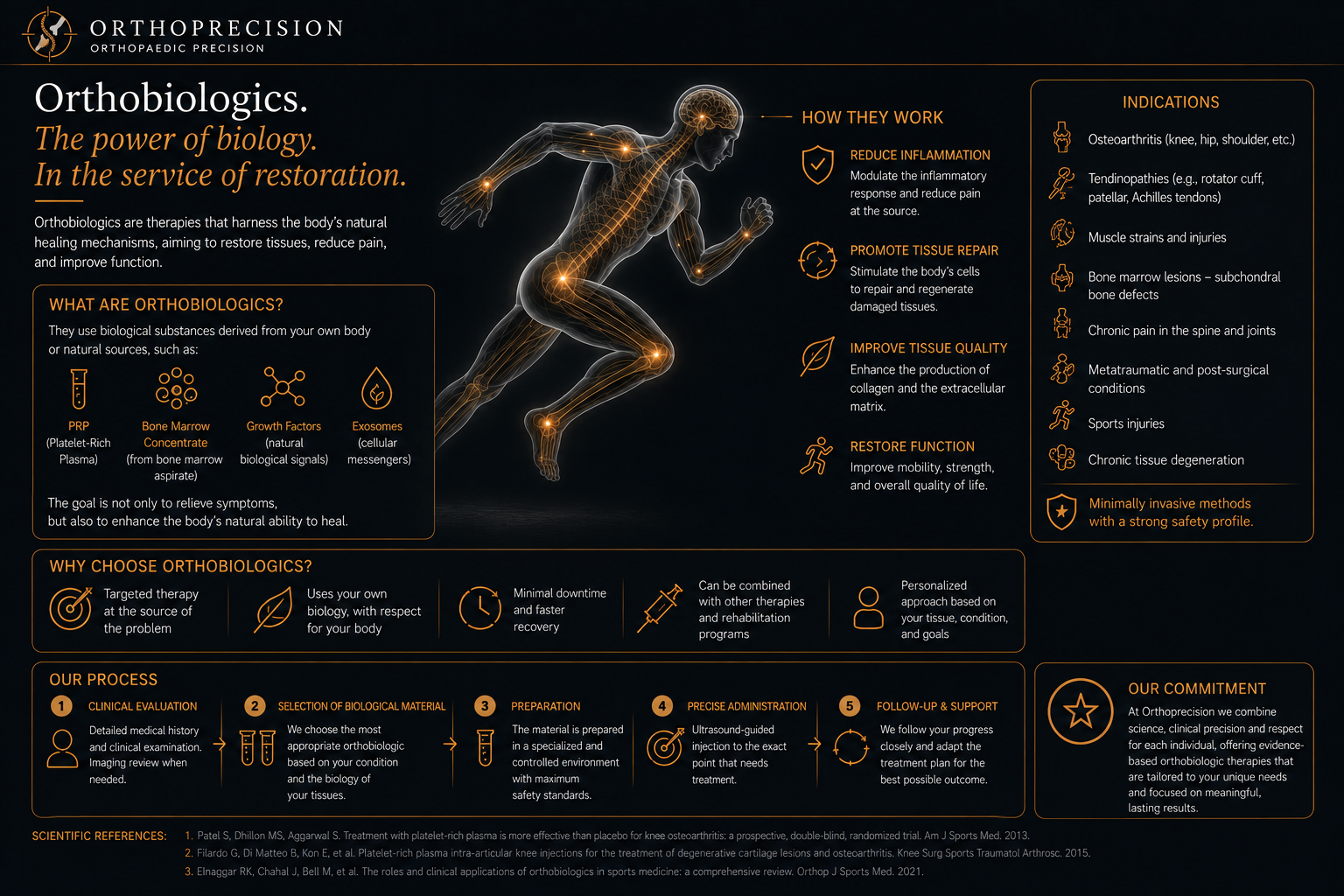
Orthobiologics represent one of the most dynamically evolving fields in modern orthopedic surgery and sports medicine. They are biological substances produced by the patient’s own body—or, in some cases, from biocompatible sources—used to enhance, accelerate, or restore the natural healing processes of musculoskeletal tissues.
The fundamental principle is both simple and revolutionary: instead of merely fighting symptoms with medications that suppress natural processes, we use the body’s own biological mechanisms—concentrated and delivered precisely—to promote recovery at the cellular level.
The term "orthobiologics" is established internationally to distinguish this category of treatment from conventional pharmacological interventions, placing it firmly within the field of evidence-based, technologically advanced orthopedic medicine.
The Modern Trend — Why Now?
The rise of orthobiologics is driven by three key factors that make this direction clinically inevitable:
Deeper Biological Understanding
The last two decades have fundamentally changed how we understand the regeneration of cartilage, tendons, and bone. We now know exactly which growth factors trigger specific processes and when.
Technological Evolution
Modern centrifugation and blood processing systems allow for the preparation of high-purity biological concentrates directly in the doctor's office within minutes.
Accumulated Clinical Data
A growing body of clinical studies documents their effectiveness, leading to their adoption by leading orthopedic centers and professional sports organizations worldwide.
Main Categories of Orthobiologics
1. Platelet-Rich Plasma (PRP)
PRP is the most common and well-studied form of orthobiologic therapy. It is produced from a small amount of the patient's blood, which is centrifuged to isolate platelets at concentrations 5 to 10 times higher than normal.
Platelets are biological "storehouses" of growth factors (such as PDGF, TGF-β, VEGF). When injected, they trigger cell proliferation and tissue remodeling. Application: We use ultrasound-guided injections to ensure the plasma is delivered with pinpoint accuracy to the affected structure.
2. Bone Marrow Aspirate Concentrate (BMAC)
BMAC is obtained by harvesting bone marrow (usually from the pelvis), which is then concentrated. It contains mesenchymal stem cells, growth factors, and anti-inflammatory cytokines. It is primarily used for non-healing tendon injuries, fracture non-unions and cartilage defects.
3. Adipose Tissue — Stromal Vascular Fraction (SVF)
Extracted from fat tissue via minimally invasive liposuction, this fraction contains a rich mix of regenerative cells. It is currently used primarily for joint conditions and is a major focus of ongoing clinical research.
Clinical Applications — Where are they used?
Joint Conditions
Knee osteoarthritis is a primary indication for PRP. Studies show it can be superior to hyaluronic acid and corticosteroids in reducing pain and improving function.
Tendon Injuries
Common indications include Tennis Elbow, Achilles tendonitis, plantar fasciitis, and rotator cuff issues—especially in chronic cases.
Cartilage Damage
Sports-related cartilage injuries can be treated with PRP or BMAC, either as a standalone therapy or to support surgical repair.
Sports Medicine
Used by world-class athletes for faster recovery, these treatments are now standard tools for elite sports clubs and national teams.
Fracture Healing
Used as a biological supplement to help heal fractures that are struggling to knit back together.
Safety and Benefits
The greatest advantage of autologous orthobiologics (those from your own body) is their exceptional safety profile. Because we use your own biological material, the risk of allergic reaction or rejection is extremely low.
What to expect: Side effects are usually limited to temporary, mild pain or swelling at the injection site for 24–72 hours. This is actually a sign that the "controlled inflammation" required for healing has been activated.
Their Role in Modern Orthopedics
Orthobiologics are not a "cure-all," nor do they replace surgery when it is truly necessary. Instead, they provide a powerful intermediate tool between conservative care (rest/medication) and the operating room.
When administered by an experienced physician with the right equipment, they offer patients a biologically enhanced recovery with minimal invasiveness and a faster return to daily life.
Would you like to see if you are a candidate for orthobiologic therapy? Contact our office today to schedule a consultation.
Book a consultation